
-300x300.jpg)
-300x300.jpg)

-300x300.jpg)

-300x300h.jpg)

-300x300.jpg)
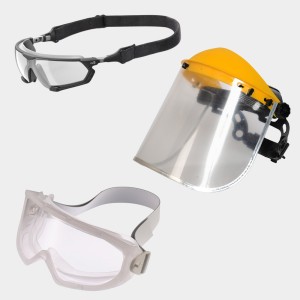

-300x300.jpg)
-300x300.jpg)
-300x300.jpg)
-300x300.jpg)
-300x300.jpg)
Eye & Face Protection

Contents
- 1. Overview
- 2. Key Standards
- 2.1 EN ISO 16321-1 – General Occupational Eye and Face Protection
- 2.2 EN 166 – Superseded but Still Widely Seen
- 2.3 EN 207 and EN 208 – Specialist Laser Eye Protection
- 2.4 PPE Regulation, CE and UKCA Marking
- 3. What the Standards Mean in Practice
- 3.1 General Requirements and Optional Protection
- 3.2 Basic Impact and Impact Levels C, D, E and HM
- 3.3 Impact Level and Protection Zones
- 3.4 Impact Markings Do Not Map Across from EN 166
- 3.5 Droplets and Streams of Liquid – 3 and 6
- 3.6 Chemical Resistance – CH
- 3.7 Dust, Gas and Fine Particles – 4 and 5
- 3.8 Resistance to Fogging and Surface Damage – N and K
- 3.9 Optical Filters, Ultraviolet and Sunglare
- 4. Types of Eye and Face Protection
- 4.1 Safety Spectacles
- 4.2 Over-Spectacles
- 4.3 Safety Goggles
- 4.4 Face Shields and Visors
- 4.5 Safety Readers
- 4.6 Prescription Safety Eyewear
- 4.7 Specialist Laser Protective Eyewear
- 5. Chemical Eye and Face Protection
- 5.1 Chemical Splash Goggles
- 5.2 Face Shields and Wider Facial Protection
- 5.3 Chemical Splash vs Chemical Resistance
- 5.4 Understanding the CH Marking
- 5.5 Polycarbonate Visors
- 5.6 Acetate Visors
- 5.7 Propionate and Other Visor Materials
- 5.8 Practical Face-Shield Selection for Semiconductor Applications
- 6. Lens Tints and Optical Radiation
- 6.1 Clear Lenses
- 6.2 Yellow and Amber Lenses
- 6.3 Blue Lenses
- 6.4 Photolithography and Yellow-Room Environments
- 7. Semiconductor and Microelectronics Applications
- 7.1 Wet Processing and Chemical Handling
- 7.2 Equipment Maintenance
- 7.3 Wafers and Brittle Materials
- 7.4 Electronics Assembly and Precision Work
- 7.5 UV and Laser-Containing Equipment
- 8. Optics and Photonics Applications
- 8.1 Optical Testing and Inspection
- 8.2 Chemical Cleaning
- 8.3 Precision Manufacturing
- 8.4 Specialist Laser Applications
- 9. Cleanroom Relevance
- 9.1 Semiconductor and Electronics Cleanrooms
- 9.2 GMP and Sterile Pharmaceutical Cleanrooms
- 9.3 Personnel Protection vs Contamination Control
- 9.4 Cleanroom Goggles – Different Reasons for Use
- 10. Compatibility, Fit and Comfort
- 10.1 Compatibility with Other PPE
- 10.2 Fit and Field of Vision
- 10.3 Fogging
- 10.4 Cleaning, Inspection and Replacement
- 11. Practical Selection Guide
- 12. Summary
1. Overview
Eye and face protection is used across semiconductor manufacturing, microelectronics, electronics, precision optics, photonics, laboratories and adjacent pharmaceutical cleanroom environments. The protection required depends on the task and the hazard present.
Potential hazards include:
- Flying particles and fragments
- Broken wafers and glass
- Liquid droplets
- Streams of liquid
- Chemicals
- Dust and fine airborne particles
- Gases and vapours
- Ultraviolet and infrared radiation
- Laser radiation
- Heat
- A combination of hazards
Safety spectacles, goggles and face shields provide different areas and levels of protection. They should not automatically be treated as interchangeable.
A safety spectacle may provide suitable protection against certain mechanical hazards while leaving areas around the eyes open. A goggle provides greater enclosure around the eye area but does not protect the remainder of the face. A face shield provides wider facial coverage but may remain open around the sides and lower edge. Depending on the task, it may therefore be used with suitable safety spectacles or goggles.
In cleanrooms, another important distinction must be made between protecting personnel from the process and protecting the process from contamination generated by personnel.
In semiconductor and electronics cleanrooms, eye protection is normally selected because the task presents an occupational hazard. An ISO cleanroom classification does not, by itself, mean that personnel must wear goggles. In some GMP sterile pharmaceutical environments, however, specialist cleanroom goggles may form part of the contamination-control gowning system.
Understanding why the protection is being worn is therefore an important first step in selecting the correct product.
2. Key Standards
2.1 EN ISO 16321-1 – General Occupational Eye and Face Protection
The principal general-use standard is EN ISO 16321-1:2022, Eye and face protection for occupational use – Part 1: General requirements, amended by A1:2025.
In the EU, the amended reference was added to the harmonised-standards list by Commission Implementing Decision (EU) 2026/1971, with effect from 4 September 2026. In Great Britain, the latest designated-standards notice available at the time of writing (notice 0140/26 of 8 August 2026) lists EN ISO 16321-1:2022 without A1:2025, alongside Parts 2 and 3.
Purchasers should therefore check the exact declaration of conformity, certificate and current standards list for the intended market, rather than assuming that the EU and GB positions are the same.
It applies to products including:
- Safety spectacles
- Over-spectacles
- Safety goggles
- Face shields and face protectors
- Protectors incorporating corrective lenses
The standard sets general requirements and also includes a number of optional performance requirements. This distinction is important.
A protector that complies with EN ISO 16321-1 does not automatically provide protection against every hazard covered by the standard. The actual protection depends on the individual requirements against which the protector has been tested.
Two products may therefore comply with the same general standard while being intended for very different applications. One may provide mechanical impact protection only. Another may additionally provide protection against droplets. Another may provide protection against gas and fine dust. A face protector may carry optional protection against streams of liquid. A protector may also carry the optional CH chemical-resistance marking.
The standard number is therefore only the starting point. The markings, declaration of conformity and manufacturer's technical information should also be checked.
EN ISO 16321-1 is Part 1 of a series. Part 2 covers additional requirements for protectors used during welding and related techniques, and Part 3 covers mesh protectors. Part 1 is the relevant part for general occupational eye and face protection.
2.2 EN 166 – Superseded but Still Widely Seen
EN 166:2001 was the long-established European standard for personal eye protection. It has now been superseded.
The EN ISO 16321 series replaces the framework previously made up of EN 166:2001 and the associated filter standards EN 169, EN 170, EN 171, EN 172 and EN 379, all of which have been withdrawn. Within that series, Part 1 covers general occupational protection, Part 2 covers welding and related techniques, and Part 3 covers mesh protectors.
From 11 November 2025, new certification is carried out to EN ISO 16321 rather than EN 166. Existing EN 166 certificates may remain valid until their stated expiry date, subject to the usual five-year maximum from the date of issue. This is not five years from November 2025, so the certificate itself should be checked. There is currently no general sell-through deadline requiring distributors to stop supplying EN 166 certified stock.
EN 175, covering equipment for eye and face protection during welding, sits outside the scope of this guide. Welding protection is covered by EN ISO 16321-2 and is not a requirement in the semiconductor, microelectronics, optics and photonics environments Lynbond supplies.
EN 166 no longer appears on the EU harmonised-standards list or the GB designated-standards list, so it no longer confers a presumption of conformity in either market.
Its markings nevertheless remain widely in circulation and are still seen on:
- Existing safety spectacles
- Goggles
- Face shields
- Technical datasheets
- Declarations of conformity
- Workplace specifications
- Existing risk assessments
Customers are therefore likely to encounter products marked to both the older EN 166 system and the newer EN ISO 16321 system, and will do so for some years. An existing EN 166 product should not automatically be regarded as unsuitable simply because a newer standard exists. Its certification, expiry date, intended use, condition and manufacturer's information should be checked.
Common EN 166 markings include:
- 3 – Liquids. Protection against liquid droplets or splashes.
- 4 – Large dust particles.
- 5 – Gas and fine dust. Protection requiring greater enclosure.
- F – Low-energy impact, 45 m/s.
- B – Medium-energy impact, 120 m/s. Commonly associated with goggles and face protection.
- A – High-energy impact, 190 m/s. The highest traditional EN 166 high-speed particle classification.
- K – Resistance to surface damage by fine particles.
- N – Resistance to fogging.
These markings describe different properties. A higher impact classification does not automatically mean that a product provides liquid or chemical protection.
Ultraviolet and sunglare filters. Filter performance previously covered by EN 170 (ultraviolet) and EN 172 (sunglare) is now covered within the EN ISO 16321 series. The new standard uses its own filter scale numbers and letter codes, which do not map directly onto the EN 170 and EN 172 scale numbers. The filter marking on the individual product should be read rather than assumed from the older designations.
2.3 EN 207 and EN 208 – Specialist Laser Eye Protection
Laser protective eyewear is a specialist area. Two standards that may be encountered are:
- EN 207 – Laser protective eyewear
- EN 208 – Laser adjustment eyewear
These remain the established route for laser eye protection and are not affected by the EN 166 to EN ISO 16321 transition.
EN 207:2017 and EN 208:2009 remain on the current GB designated standards list. EN ISO 19818-1 covers protection against laser radiation and may also be referenced in manufacturers' product documentation. It is not currently listed as a GB designated PPE standard and should not be treated as an equivalent conformity route without checking the individual product's declaration of conformity and certificate.
These standards are relevant where personnel may be exposed to accessible laser radiation. Potential applications include:
- Photonics laboratories
- Optical alignment
- Equipment development
- Research
- Service and maintenance
- Laser wafer scribing and marking
- Specialist semiconductor equipment
In semiconductor manufacturing, laser protective eyewear may be required for wafer scribing, wafer marking and serial-number identification, as well as for equipment set-up, maintenance, alignment and development work. The requirement depends on the laser classification, wavelength, accessible emission and the safeguards designed into the equipment.
Laser protective eyewear must be selected for the actual laser wavelength and operating conditions. Ordinary safety spectacles, tinted lenses and general UV-filtering eyewear should not be assumed to provide laser protection.
Lynbond does not supply laser protective eyewear. See Section 4.7.
2.4 PPE Regulation, CE and UKCA Marking
Eye and face protection is regulated as personal protective equipment. The standard tells you what the product has been tested to. The regulation determines how it is assessed, marked and documented.
In the European Union, eye and face protection falls under Regulation (EU) 2016/425 and carries CE marking. Harmonised standards giving a presumption of conformity are listed in the Official Journal of the European Union, consolidated by Commission Implementing Decision (EU) 2026/1279 of 12 June 2026 and subsequently amended by Decision (EU) 2026/1971 of 4 September 2026.
In Great Britain, the equivalent requirements are set out in Regulation 2016/425 as retained in UK law, supported by a separate UK designated standards list. Great Britain continues to recognise CE marking alongside UKCA marking for PPE, following the Product Safety and Metrology etc. (Amendment) Regulations 2024, so a CE-marked protector may be placed on the GB market without a separate UKCA mark. UKCA remains available but is not the only permitted route.
The two standards lists are closely aligned but maintained independently, and they can diverge for a period after a new amendment is published. The EU list should not be assumed to settle GB status, or the reverse.
Most general-purpose eye protection is Category II. Where a protector is intended to protect against hazards listed in Annex I of the Regulation, such as harmful chemical substances or ionising radiation, it falls within Category III and is subject to additional conformity assessment and ongoing production surveillance.
In practice this means the declaration of conformity should be available, should identify the standards and optional requirements the product has actually been assessed against, and should be read alongside the markings on the product itself.
3. What the Standards Mean in Practice
3.1 General Requirements and Optional Protection
EN ISO 16321-1 contains general requirements that every protector must meet, together with optional requirements for particular hazards or performance characteristics.
Examples of the optional requirements include:
- Droplets
- Streams of liquid
- Large dust particles
- Gas and fine dust
- Chemical resistance
- Surface damage
- Fogging
- Different levels of mechanical impact
A product may only carry the relevant marking when that specific requirement has been tested and met.
This means that the description safety goggle, chemical visor or safety spectacle is not enough on its own to establish suitability. The markings and technical information should be checked.
3.2 Basic Impact and Impact Levels C, D, E and HM
Impact performance under EN ISO 16321-1 has two parts, and the distinction is often missed.
Basic impact. All protectors covered by the standard must pass a basic impact test using a dropped steel ball. This is a general requirement rather than an optional one, and it carries no marking. A protector with no impact letter on it has still been tested to this basic level.
Optional impact levels. Higher impact performance is tested against high-speed projectiles and is marked as follows:
| Marking | Meaning |
|---|---|
| C | Impact level C – 45 m/s |
| D | Impact level D – 80 m/s |
| E | Impact level E – 120 m/s |
| HM | High-mass impact, using a heavier projectile at lower speed |
| CT | Impact level C at extremes of temperature |
| DT | Impact level D at extremes of temperature |
| ET | Impact level E at extremes of temperature |
| HMT | High-mass impact at extremes of temperature |
The correct level depends on the foreseeable mechanical hazard. Examples within semiconductor and electronics environments can include:
- Component lead cutting
- Wire cutting
- Broken wafers
- Broken glass
- Equipment servicing
- Pressurised systems
- Maintenance work
Higher impact performance does not automatically provide better chemical or liquid protection. The different claims should be considered separately.
3.3 Impact Level and Protection Zones
EN ISO 16321-1 links impact performance to the area of the face that must be protected. This is a change from EN 166, where impact classification was more closely tied to the product category.
The standard defines protection zones covering progressively larger areas:
- Orbital protection zone – the area immediately around the eyes
- Extended orbital protection zone – a larger area around and beyond the eye sockets
- Face protection zone – the wider face
Impact level C is associated with the orbital protection zone, level D with the extended orbital protection zone, and level E with the face protection zone.
The practical consequence is that impact level and coverage are no longer separate selection questions. A higher impact marking implies that a larger area of the face has been protected to that level, which is a useful point when comparing a spectacle against a goggle or face shield.
3.4 Impact Markings Do Not Map Across from EN 166
This is the single most common source of confusion during the transition, and it matters commercially as well as technically.
The impact letters used in EN ISO 16321-1 are not an upgraded version of the EN 166 letters. They are a different scheme, and the speeds do not line up:
| EN 166 | Speed | EN ISO 16321-1 | Speed |
|---|---|---|---|
| F | 45 m/s | C | 45 m/s |
| B | 120 m/s | D | 80 m/s |
| A | 190 m/s | E | 120 m/s |
Reading across the rows shows the problem. A product marked D has been tested at 80 m/s, which is lower than the 120 m/s associated with EN 166 B, and EN ISO 16321-1 has no level equivalent to the 190 m/s of EN 166 A. Someone replacing a B-rated goggle with a D-rated goggle on the assumption that D follows B alphabetically would be selecting a lower projectile speed.
Some manufacturers continue to test at the higher EN 166 speeds and state both sets of performance on their documentation. Where a like-for-like replacement is being specified, the tested speed should be compared rather than the letter.
The protection zone should be compared as well, as described in Section 3.3, since the coverage requirement also differs between the two schemes.
Electrical arc. EN 166 included the marking 8 for electrical arc. EN ISO 16321-1 does not simply omit an equivalent marking: its scope expressly excludes face protectors intended for live working against short-circuit electric arcs, for which IEC 62819 applies. Where protection against electrical arc is required, task-specific certification to the appropriate standard must be confirmed. It cannot be inferred from a general eye protection standard.
3.5 Droplets and Streams of Liquid – 3 and 6
EN ISO 16321-1 distinguishes between two different types of liquid exposure.
3 – Droplets. An optional requirement for protection against droplets.
6 – Streams of liquid. A separate optional requirement for protection against streams of liquid.
The distinction is important. A small droplet exposure and a more substantial stream of liquid present different physical challenges. A product carrying 3 should not automatically be assumed to provide 6.
Similarly, a product carrying either liquid marking should not automatically be regarded as resistant to the chemical itself.
3.6 Chemical Resistance – CH
Chemical resistance is a separate optional requirement identified by the marking CH.
A protector carrying CH has been subjected to controlled chemical exposure and must continue to satisfy specified requirements afterwards. This is different from simply demonstrating that liquid did not reach the wearer.
Chemical resistance is discussed in more detail in Section 5.
3.7 Dust, Gas and Fine Particles – 4 and 5
The standard includes:
- 4 – Large dust particles
- 5 – Gas and fine dust particles
These requirements are particularly relevant where greater enclosure around the eyes is necessary.
A product should not be assumed to provide this protection merely because it is described as a goggle. The specific marking should be confirmed.
3.8 Resistance to Fogging and Surface Damage – N and K
Two useful optional performance markings are:
- N – Resistance to fogging
- K – Resistance to surface damage by fine particles
These can be particularly relevant where eyewear is worn for extended periods or in combination with:
- Face masks
- Cleanroom hoods
- Respirators
- Chemical hoods
The presence of an anti-fog coating does not automatically mean that the product has passed the optional N requirement. The product marking or technical specification should confirm this.
3.9 Optical Filters, Ultraviolet and Sunglare
Optical filters may be used where personnel require protection against ultraviolet or infrared radiation. Filter performance for general occupational ultraviolet, infrared and sunglare hazards is now covered within EN ISO 16321-1 rather than by the separate EN 170, EN 171 and EN 172 standards. Welding filters previously covered by EN 169 and EN 379 fall within the scope of EN ISO 16321-2.
Selection should be based on:
- Wavelength
- Intensity
- Exposure conditions
- Filter performance as marked on the product
Lens colour alone does not establish the level of protection. A yellow, amber, blue or dark lens may alter visible-light transmission or contrast without necessarily providing the required protection against hazardous optical radiation.
4. Types of Eye and Face Protection
4.1 Safety Spectacles
Safety spectacles are commonly used for mechanical eye protection. Typical advantages include:
- Low weight
- Good field of vision
- Ease of use
- Suitability for extended wear
- Wraparound or side-protection options
They can be appropriate for activities such as:
- Component trimming
- Wire cutting
- Electronics repair
- Equipment maintenance
- Handling brittle components
However, safety spectacles do not fully enclose the eyes. They should not automatically be selected where significant liquid, fine dust or gas exposure is possible.
4.2 Over-Spectacles
Over-spectacles are designed to fit over ordinary prescription glasses. They can be useful for:
- Visitors
- Occasional users
- Short-duration tasks
- Workplaces with changing personnel
Fit should be checked carefully. The over-spectacle should not:
- Push the prescription glasses against the face
- Become unstable
- Restrict vision
- Create excessive pressure
- Interfere with other PPE
Ordinary prescription glasses should not be treated as certified occupational safety eyewear.
4.3 Safety Goggles
Goggles provide greater enclosure around the eyes. Depending on their certification, they may provide protection against:
- Mechanical impact
- Droplets
- Large dust particles
- Gas and fine dust
- Chemical exposure
Not all goggles provide the same protection.
Directly ventilated goggles. Direct ventilation improves airflow but creates openings through which liquids or fine contamination may potentially enter.
Indirectly ventilated goggles. The ventilation path is designed to reduce direct entry. These can be suitable for some liquid applications where the relevant optional protection has been demonstrated.
Non-ventilated goggles. Non-ventilated goggles provide greater enclosure but may increase the risk of fogging.
The description goggle alone is therefore not enough to establish suitability.
4.4 Face Shields and Visors
Face shields provide wider coverage than spectacles or goggles. Depending on the design, they may protect:
- Eyes
- Forehead
- Front of the face
- Sides of the face
- Chin and lower face
Depending on their certification, face shields may provide protection against:
- Mechanical impact
- Streams of liquid
- Chemical exposure
A face shield should not automatically be treated as a substitute for suitable eye protection. For some applications it is secondary protection worn over safety spectacles or goggles.
4.5 Safety Readers
Safety readers combine certified occupational eye protection with a magnifying section, usually in the lower part of the lens.
Common strengths include +1.5, +2.0 and +2.5.
They can be useful for:
- Reading small component markings
- Precision assembly
- Visual inspection
- Reading instruments and displays
- Electronics repair
- Detailed maintenance work
This can remove the need to repeatedly change between ordinary reading glasses and safety spectacles during close work.
4.6 Prescription Safety Eyewear
Where full visual correction is required, prescription safety eyewear may be appropriate. Options can include:
- Single-vision lenses
- Bifocal lenses
- Progressive or varifocal lenses
Ordinary prescription spectacles should not automatically be treated as occupational safety eyewear.
Over-spectacles, safety readers and prescription safety eyewear are separate solutions rather than steps in a sequence. The appropriate option should be selected through an assessment of the individual's vision and the task, not by working through them in order.
4.7 Specialist Laser Protective Eyewear
Laser protective eyewear is selected according to the specific laser hazard. It is primarily relevant to:
- Photonics
- Optical laboratories
- R&D
- Alignment
- Specialist equipment maintenance
It is not normally a general cleanroom eyewear requirement.
Lynbond does not supply laser protective eyewear.
Laser eye protection is a highly specialist product. The correct filter must be matched to the wavelength, power, pulse characteristics and operating conditions of the specific laser, and the required optical density should be determined by the organisation's Laser Safety Officer or other competent person. Selecting it from a general catalogue description is not appropriate.
Where laser protective eyewear is required, we recommend contacting a specialist laser safety supplier, such as Edmund Optics.
Lynbond can continue to supply the general occupational eye and face protection used alongside laser work, including safety spectacles, goggles and face shields for impact, chemical and particulate hazards. These do not provide laser protection and are not a substitute for it.
5. Chemical Eye and Face Protection
Chemical handling is one of the most important eye and face protection areas within semiconductor manufacturing. Potential activities include:
- Wet processing
- Chemical transfer
- Decanting
- Chemical sampling
- Line intervention
- Line breaking
- Equipment cleaning
- Equipment maintenance
- Solvent cleaning
- Spill response
The assessment should consider:
- Chemical identity
- Concentration
- Quantity
- Temperature
- Pressure
- Method of handling
- Likely direction of release
- Possible duration of contact
- Area of the face potentially exposed
5.1 Chemical Splash Goggles
Where liquid could reach the eyes, goggles generally provide greater enclosure than safety spectacles.
However, a goggle should only be described as providing droplet protection where the relevant certification confirms this. For EN ISO 16321-1 this means looking for the optional 3 marking for droplets.
For higher-risk applications, chemical compatibility of the lens, frame, seal and strap should also be considered.
5.2 Face Shields and Wider Facial Protection
A face shield can protect a much larger area than goggles alone. This can be important where a chemical release could reach the forehead, cheeks, mouth, chin or wider facial area.
Face shields may be particularly useful during:
- Chemical transfer
- Decanting
- Maintenance
- Line breaking
- Spill response
However, a face shield remains relatively open. Depending on the risk assessment, goggles may also be required beneath it.
5.3 Chemical Splash vs Chemical Resistance
Liquid protection and chemical resistance are not the same thing. Three separate questions should be asked:
- Does the product provide suitable physical coverage against the liquid exposure?
- Has it demonstrated optional chemical resistance?
- Are the materials actually compatible with the chemical being handled?
These questions should not be merged into one. A protector may carry 3 without CH, 6 without CH, CH together with 3, or CH together with 6.
The liquid marking describes the physical form of exposure. The CH marking provides additional evidence about the protector's performance following controlled chemical exposure.
5.4 Understanding the CH Marking
To claim CH, protectors are tested against a specified minimum group of chemicals:
- Sulphuric acid at 30 ± 2% aqueous concentration
- Sodium hydroxide at 10 ± 1% aqueous concentration
- Undiluted p-xylene
- Undiluted butan-1-ol
- Undiluted n-heptane
The test involves pouring a specified quantity of the chemical over the whole protector, including its assembly and retention system, over a short defined period, followed by a short dwell time before rinsing and drying.
Following exposure, the protector must continue to meet specified requirements. These include:
- No visible distortion
- Continued optical performance
- Continued practical operation
- Secure fastenings and retention
- Continued claimed impact protection
- Continued resistance to ignition
In other words, the CH marking confirms that the protector continued to meet specified functional, optical and mechanical requirements after controlled exposure to five defined chemicals. It is a durability test of the protector. It is not a general guarantee of wearer protection against chemicals, and it does not establish permeation resistance, breakthrough time or compatibility with other substances.
What CH does not mean. The CH marking is not equivalent to the permeation or breakthrough-time testing commonly associated with chemical protective gloves and clothing. It does not provide:
- A breakthrough time in minutes
- Universal chemical resistance
- Performance against every concentration
- Performance at every temperature
- Evidence for prolonged immersion
- Evidence for every semiconductor process chemical
- Automatic suitability for high-pressure releases
A product carrying CH has demonstrated continued performance after the specified test exposure. The actual chemical application still needs to be considered.
5.5 Polycarbonate Visors
Polycarbonate is one of the most widely used face-shield materials. Typical advantages include:
- High impact resistance
- Good optical clarity
- Useful flexibility
- Good heat resistance
- Wide availability
For semiconductor applications, its flexibility can also make replacement visors relatively straightforward to fit.
However, polycarbonate is not universally resistant to chemicals. Certain solvents and chemicals can cause:
- Crazing
- Stress cracking
- Clouding
- Surface damage
- Reduction in mechanical strength
The actual chemical compatibility should therefore be checked.
5.6 Acetate Visors
Acetate is widely associated with chemical splash protection. Potential advantages include:
- Good optical clarity
- Good scratch resistance
- Better performance than polycarbonate against certain chemicals and solvents
However, acetate is generally less impact resistant than polycarbonate, and stiffer.
The stiffness can affect practical use. Lynbond has received customer feedback that an acetate replacement visor was extremely difficult to attach to the headgear. This demonstrates why visor selection should not be based on material properties alone.
A visor must also be practical to fit, remove, inspect, clean and replace. User trials can therefore be useful before changing visor material.
5.7 Propionate and Other Visor Materials
Propionate is used on some specialist chemical face-protection systems. Depending on the product, it can offer a useful combination of chemical resistance, optical performance and impact resistance.
However, many propionate visor systems are designed for heavier industrial or helmet-mounted applications. These may be suitable for chemical plants, utilities, heavy maintenance and industrial processing, but less suitable for routine semiconductor cleanroom use where personnel generally prefer:
- Standalone headgear
- No safety helmet unless required
- Good visibility
- Balanced weight
- Easy visor replacement
Other visor materials, such as PETG, may also be available. Their impact, heat and chemical performance should be checked against the intended application.
5.8 Practical Face-Shield Selection for Semiconductor Applications
For semiconductor wet processing and chemical maintenance work, a standalone head-mounted face shield can be a practical option where the risk assessment calls for wider facial protection.
Important characteristics include:
- Wide field of vision
- Forehead coverage
- Side protection
- Lower-face and chin coverage
- Ratchet adjustment
- Compatibility with goggles
- Compatibility with respirators
- Replaceable visors
- Balanced weight
- Ease of use
The Honeywell Bionic face shield is an example of this type of design. The Bionic system provides extended chin and top-of-head protection, ratchet adjustment and a large range of possible positions, and the standard face-shield system is used without a helmet.
The range includes both polycarbonate and acetate visor options.
Polycarbonate options include a complete shield with clear uncoated polycarbonate, and replacement polycarbonate screens, including an anti-scratch and Fog-Ban coated version.
Acetate options include a complete shield with clear uncoated acetate.
Complete shields and replacement screens should always be ordered by exact part number. A replacement screen is not a complete assembly, and the two are easily confused.
This allows customers to consider the relative benefits of polycarbonate and acetate while retaining the same general headgear design.
Much of the Bionic documentation quotes the North American standards ANSI Z87.1 and CSA Z94.3. Where European performance is required, the EN markings on the specific part number should be confirmed, particularly for the acetate visor, rather than assumed from the range as a whole.
The final choice should consider:
- Chemical compatibility
- Impact requirement
- Visor flexibility
- Optical clarity
- Fogging
- Ease of fitting
- Frequency of replacement
- User acceptance
There is no single ideal visor material for every semiconductor chemical-handling application.
6. Lens Tints and Optical Radiation
6.1 Clear Lenses
Clear lenses are generally preferred where:
- Maximum visible-light transmission is required
- Colour recognition is important
- Work is primarily indoors
- Precision visual inspection is required
Some clear polycarbonate safety lenses also provide substantial UV filtration. Where occupational UV protection is required, however, the certified filter performance should be checked rather than relying on material alone.
6.2 Yellow and Amber Lenses
Yellow and amber lenses may affect perceived contrast and definition, depending on the spectral transmittance of the lens, the lighting and the task. They are sometimes preferred for inspection, electronics work and precision assembly, but tint colour alone does not demonstrate a benefit.
However, yellow or amber colour does not automatically mean that the lens provides occupational UV protection. The relevant filter performance must be checked.
6.3 Blue Lenses
Blue-tinted lenses may affect perceived comfort or contrast under some indoor or yellow-dominant lighting conditions, again depending on spectral transmittance, lighting and task.
They should not automatically be regarded as protection against hazardous UV radiation. Lens tint and optical protection are separate considerations.
6.4 Photolithography and Yellow-Room Environments
Yellow lighting in semiconductor photolithography areas is primarily used to protect photosensitive materials. It does not automatically mean that personnel require yellow UV-protective eyewear.
Where ultraviolet radiation is enclosed or interlocked, operators may have no direct exposure during normal use.
Requirements can change during maintenance, servicing, development and testing, where the source may become accessible.
7. Semiconductor and Microelectronics Applications
7.1 Wet Processing and Chemical Handling
Semiconductor wet processing can involve acids, alkalis, oxidising chemicals, solvents, etchants and cleaning chemicals.
Potential higher-risk activities include:
- Decanting
- Chemical transfer
- Maintenance
- Line breaking
- Equipment intervention
- Cleaning
- Spill response
Depending on the assessment, suitable eye and face protection may include chemical splash goggles, face shields, goggles plus a face shield, or other compatible chemical PPE.
7.2 Equipment Maintenance
Maintenance activities can create hazards that are not present during normal equipment operation. Examples include:
- Chemical residues
- Pressurised systems
- Flying particles
- Broken components
- Dust
- Accessible UV sources
- Accessible laser sources
Maintenance personnel may therefore require different PPE from routine production operators.
7.3 Wafers and Brittle Materials
Silicon wafers, glass and similar brittle materials can fracture. Sharp fragments may be generated during:
- Manual handling
- Breakage recovery
- Equipment intervention
- Maintenance
- Cutting or processing
Suitable impact protection should be considered where fragments could reach the eyes.
7.4 Electronics Assembly and Precision Work
Mechanical eye hazards also occur during everyday electronics work. Examples include:
- Component lead cutting
- Wire cutting
- Trimming
- Rework
- Hand-tool use
- Equipment repair
These tasks may be well suited to lightweight safety spectacles. Safety readers can also be useful where close visual work is required.
7.5 UV and Laser-Containing Equipment
The presence of UV or laser technology within semiconductor equipment does not automatically mean that operators require specialist eyewear. Many sources are enclosed, interlocked and inaccessible during normal operation.
Requirements may change where radiation becomes accessible, for example during:
- Laser wafer scribing and marking
- Servicing
- Alignment
- Maintenance
- Development
Laser scribing and marking systems used to apply wafer identification and serial numbers can create a genuine laser eyewear requirement, depending on the laser classification, the accessible emission and how the machine is guarded during operation and set-up.
The actual exposure should determine the PPE requirement.
8. Optics and Photonics Applications
8.1 Optical Testing and Inspection
Optics and photonics work can involve precision visual inspection, small components, fragile optical materials and specialist lighting.
Lightweight safety spectacles or safety readers may be appropriate for many routine activities.
8.2 Chemical Cleaning
Optical components may be cleaned using solvents, cleaning agents and specialist process chemicals.
Where liquid exposure is foreseeable, goggles or face protection may be required. The compatibility of the lens or visor material with the cleaning chemical should also be checked.
8.3 Precision Manufacturing
Optical manufacture can involve grinding, cutting, polishing, machining and brittle substrates.
Mechanical impact protection may therefore be required.
8.4 Specialist Laser Applications
Photonics and optical R&D are more likely than routine electronics manufacturing to involve accessible laser beams.
Where laser exposure is possible, eyewear should be selected specifically for the wavelength, the laser operating conditions and the task.
General safety eyewear is not a substitute for laser protective eyewear.
9. Cleanroom Relevance
9.1 Semiconductor and Electronics Cleanrooms
An ISO cleanroom classification does not automatically require goggles.
Within semiconductor and electronics environments, eye protection is normally selected because of the process hazard. Examples include:
- Chemical liquid exposure
- Flying particles
- Broken wafers
- Dust
- UV radiation
- Laser radiation
The requirement comes from the task, not simply from the cleanroom classification.
9.2 GMP and Sterile Pharmaceutical Cleanrooms
Sterile pharmaceutical environments may have different requirements. Personnel can themselves be an important source of particles and microbiological contamination.
Specialist cleanroom goggles may therefore form part of the contamination-control gowning system. Requirements may include:
- Low-shedding materials
- Controlled cleaning
- Disinfection
- Sterilisation
- Autoclave compatibility
- Compatibility with masks and hoods
- Resistance to repeated processing
This is different from simply selecting safety eyewear for an occupational hazard.
9.3 Personnel Protection vs Contamination Control
Two separate questions should be considered. Does the eyewear protect the wearer against the identified hazard? And is the eyewear suitable for the controlled environment?
A product can perform well in one respect without necessarily meeting the other.
9.4 Cleanroom Goggles – Different Reasons for Use
A sterile autoclavable goggle may be highly suitable for pharmaceutical contamination control but may not necessarily provide the chemical protection required at a semiconductor wet bench.
Conversely, an industrial chemical goggle may offer excellent personnel protection while being unsuitable for a critical sterile environment.
The term cleanroom goggle should therefore not be treated as a single performance category.
10. Compatibility, Fit and Comfort
10.1 Compatibility with Other PPE
Eye and face protection may need to be worn with:
- Cleanroom hoods
- Face masks
- Chemical hoods
- Half-mask respirators
- Full-face respirators
- Powered respirators
- Protective clothing
Poor compatibility can:
- Move eyewear out of position
- Create gaps
- Interfere with respirator seals
- Restrict visibility
- Increase fogging
- Prevent a visor from closing correctly
The complete PPE combination should be considered together.
10.2 Fit and Field of Vision
Selection should consider face shape, head size, temple adjustment, nose fit, goggle strap adjustment, field of vision, pressure points, weight and balance.
A protector that is uncomfortable or unstable is less likely to be worn correctly.
Fit has become more prominent under EN ISO 16321-1, which uses a wider range of headforms than EN 166 and links impact performance to defined protection zones. A protector sitting incorrectly on the face may not deliver the coverage its marking implies.
10.3 Fogging
Fogging can become a significant problem when eyewear is worn with face masks, cleanroom hoods, respirators, chemical hoods or non-ventilated goggles.
Resistance to fogging is an optional performance requirement identified by the marking N.
An anti-fog coating should not automatically be assumed to mean that the product has passed this test.
10.4 Cleaning, Inspection and Replacement
Eye and face protection should be inspected for:
- Cracks
- Deep scratches
- Clouding
- Crazing
- Stress cracking
- Chemical staining
- Damaged frames
- Deteriorated seals
- Damaged straps
- Loose fittings
- Reduced optical clarity
Following chemical exposure, also consider softening, swelling, distortion, discolouration, loss of flexibility and damage to coatings.
Reusable products should be cleaned according to the manufacturer's instructions. Unapproved solvents may damage polycarbonate, acetate, lens coatings, anti-fog treatments and frame materials.
Where significant chemical exposure has occurred and the effect on the product is uncertain, replacement should be considered.
11. Practical Selection Guide
Step 1 – Identify the hazard. Is the hazard impact, droplets, streams of liquid, chemical exposure, dust, gas or fine particles, UV or infrared radiation, laser radiation, or a combination?
Step 2 – Understand the exposure. Consider direction, severity, concentration, temperature, pressure, quantity, duration, wavelength where applicable, and whether the exposure is routine or occurs during maintenance. Where lasers are present, including wafer scribing and marking systems, consider the laser classification, the accessible emission and whether the beam can be reached during operation, set-up or servicing.
Step 3 – Select the form of protection. Does the task require safety spectacles, over-spectacles, safety goggles, a face shield, goggles and a face shield, safety readers, prescription safety eyewear or specialist laser protective eyewear? Laser protective eyewear is not supplied by Lynbond and should be sourced from a specialist laser safety supplier.
Step 4 – Check the tested claims. Confirm the relevant markings and manufacturer's information. Do not rely only on descriptions such as safety glasses, chemical goggles, chemical visor, UV glasses or cleanroom goggles.
Step 5 – Check which standard the product is certified to. Establish whether the protector is certified to EN ISO 16321-1 or to EN 166, and confirm the certificate is current. Where an EN 166 product is being replaced, compare the tested projectile speeds rather than the impact letters, because the two schemes do not align. See Section 3.4.
Step 6 – For chemical and liquid hazards, check three things separately.
- Physical liquid protection. Does the protector carry the appropriate 3 marking for droplets or 6 marking for streams of liquid?
- Chemical resistance. Does the product carry the optional CH marking where relevant?
- Material compatibility. Are the lens, visor, frame and seal materials suitable for the actual chemical being handled?
Step 7 – Consider the visor material. For face shields, consider polycarbonate, acetate, propionate or other transparent visor materials, and assess chemical compatibility, impact requirement, flexibility, optical performance, ease of fitting and user acceptance.
Step 8 – Check fit and PPE compatibility. Make sure the protector fits the wearer, remains correctly positioned, works with cleanroom hoods, does not interfere with respirators, maintains visibility and does not create unacceptable fogging.
Step 9 – Consider the controlled environment. Where relevant, consider cleanroom suitability, particle generation, ESD requirements, cleaning, disinfection and sterilisation.
Step 10 – Establish inspection and replacement procedures. Determine how the product will be inspected, cleaned, stored, replaced following damage and replaced following significant chemical exposure.
12. Summary
Effective eye and face protection selection involves more than choosing a product described as safety glasses, chemical goggles or a face shield.
The selection should bring together the hazard, the exposure, the protector type, the tested performance, the materials, fit, compatible PPE, cleanroom requirements, and inspection and care.
The EN ISO 16321 series provides the current certification framework for occupational eye and face protection, and has superseded EN 166 together with the EN 169, EN 170, EN 171, EN 172 and EN 379 filter standards. Existing EN 166 certificates may remain valid until their stated expiry dates, and products bearing the older markings will remain in circulation for some years, so both systems need to be understood. The impact letters used by the two standards do not correspond, and should be compared by tested speed rather than by letter.
The markings on the individual protector identify the particular performance that has been demonstrated.
For chemical applications, three separate considerations are especially important: physical liquid protection, optional chemical resistance, and compatibility of the actual lens, visor and other materials with the chemical being handled.
For semiconductor and related technical environments, practical usability is also important. Protection should be suitable for the hazard while remaining comfortable, compatible with other PPE and realistic for personnel to wear throughout the task.
Lynbond supplies eye and face protection for semiconductor, microelectronics, electronics, optics, photonics and adjacent controlled environments. We do not supply laser protective eyewear, and recommend contacting a specialist laser safety supplier for that requirement.
Where the correct selection is unclear, contact Lynbond with details of the process, hazard, chemical and working environment.